ExpertFX Podcast - No time to read? Let me read it for you. Press Play!
In the first half of the US session on Monday, gold trades around $4,170 per ounce, retreating from an intraday high of $4,217 reached in the Asian session and facing resistance near the short-term level 4,171.00 (EMA200 on the hourly XAU/USD chart). The metal failed to hold above the psychological level of $4,200 as a stronger US dollar and rising oil prices limit recovery potential. The market is frozen, awaiting the US inflation release scheduled for Wednesday.
What supports gold
Record inflows into gold ETFs. According to the World Gold Council, global gold ETFs attracted $10 billion in September, and cumulative inflows for Q3 reached a record $31 billion. Despite an 8.5% decline in gold prices in September, purchases rose 67 tonnes to a record 4,256 tonnes. This indicates institutional investors view the current correction as an opportunity to add positions rather than exit.
Sustained central bank purchases. In August, central banks reported net purchases of 39 tonnes, bringing cumulative purchases year-to-date to 170 tonnes. The People's Bank of China increased reserves by 20 tonnes in August — the 22nd consecutive month — raising total holdings to 2,387 tonnes. Poland remains the largest buyer year-to-date (98 tonnes), approaching its target of 700 tonnes. This structural demand is independent of short-term Federal Reserve decisions.
Geopolitical tension remains in the background. Houthi attacks on Riyadh's international airport over the weekend killed 12 people, and President Trump allowed for possible US involvement in retaliatory strikes. The situation around the Strait of Hormuz continues to create energy supply risks, supporting a geopolitical risk premium.
What weighs on gold
A strong dollar remains the main headwind. The USDX trades around 102.30–102.40, holding near 18-month highs. A strong dollar makes gold more expensive for holders of other currencies and limits upside potential.
Bond yields at multi-year highs. The 10-year US Treasury yield holds near 5.24%, close to last week's peak of 5.36% — the highest level since 2002. For gold, which yields no interest, this represents a high opportunity cost of holding the metal.
Rising oil prices increase inflationary risks. Brent trades above $103 per barrel after Iran rejected the US proposal to reopen navigation in the Strait of Hormuz as insufficient. Higher energy prices boost inflation expectations, supporting a hawkish Fed stance and pressuring gold.
The market awaits CPI. Investors avoid opening large positions ahead of the US inflation print on Wednesday. Consensus forecasts imply headline annual inflation will accelerate to 3.7% from 3.4% and core CPI will rise to 2.5% from 2.4%. Strong data could revive expectations of an October rate hike, which would pressure gold.
Short technical analysis
The technical picture remains bearish, but the metal shows signs of stabilization.
Consolidated technical analysis on the hourly chart signals "Sell": 11 of 23 applied indicators favor short positions.
Gold has traded between 4100 and 4200 for two weeks, and neither bulls nor bears show strong conviction. RSI (14) on the daily chart is around 44, below the neutral 50, indicating weak buying interest.
Conclusion and recommendations
Gold consolidates near 4170.00, stuck between support 4100.00 and resistance 4225.00. The key level for bulls remains 4230.00; for bears — 4150.00.
For short-term traders:
Consider long positions on a sustained breakout above 4235.00, targeting 4256.00–4300.00, with a stop loss below 4150.00.
Consider short positions on a break below 4150.00, targeting 4100.00–4066.00, with a stop loss above 4235.00.
Watch CPI (October 14) closely — it is the key trigger for movement.
For medium?term investors:
A potential pullback to 4100.00–4066.00 can be used to cautiously add long positions, provided structural demand from central banks and ETFs remains intact.
HSBC notes that gold remains an attractive diversification asset amid geopolitical uncertainty and fiscal risks.
Risk management:
Account for increased volatility around inflation releases.
Use stop losses strictly, especially when trading breakouts of key levels.
Monitor bond yields, oil prices, and Fed comments.
This review is based on open sources and media reports and represents an analysis of price dynamics affected by many factors; risk management and position control are therefore especially important.
PREMIUM - EXPERTFX SCHOOL
Elite Operations: Military discipline applied to the financial market. Join us.
You can article now and register later.
If you have an account, sign in now to article with your account.
Note: Your article will require moderator approval before it will be visible.
Discover exactly where Smart Money is moving capital in real-time. By registering on our platform, you unlock the complete ExpertFX ecosystem: high-precision consensus algorithms, millimetric technical data, and elite educational guides on risk and emotional management. Secure your spot in the free environment before the VIP transition.




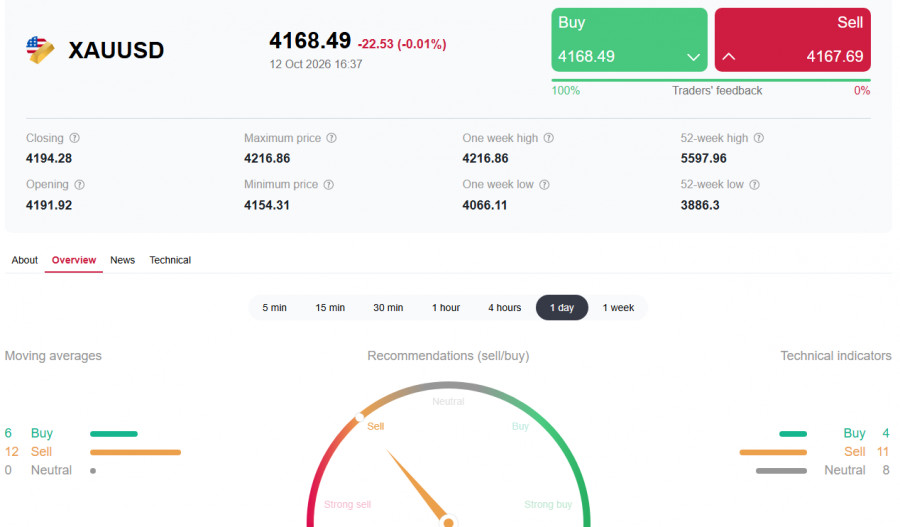
In the first half of the US session on Monday, gold trades around $4,170 per ounce, retreating from an intraday high of $4,217 reached in the Asian session and facing resistance near the short-term level 4,171.00 (EMA200 on the hourly XAU/USD chart). The metal failed to hold above the psychological level of $4,200 as a stronger US dollar and rising oil prices limit recovery potential. The market is frozen, awaiting the US inflation release scheduled for Wednesday.What supports gold
Record inflows into gold ETFs. According to the World Gold Council, global gold ETFs attracted $10 billion in September, and cumulative inflows for Q3 reached a record $31 billion. Despite an 8.5% decline in gold prices in September, purchases rose 67 tonnes to a record 4,256 tonnes. This indicates institutional investors view the current correction as an opportunity to add positions rather than exit.
Sustained central bank purchases. In August, central banks reported net purchases of 39 tonnes, bringing cumulative purchases year-to-date to 170 tonnes. The People's Bank of China increased reserves by 20 tonnes in August — the 22nd consecutive month — raising total holdings to 2,387 tonnes. Poland remains the largest buyer year-to-date (98 tonnes), approaching its target of 700 tonnes. This structural demand is independent of short-term Federal Reserve decisions.
Geopolitical tension remains in the background. Houthi attacks on Riyadh's international airport over the weekend killed 12 people, and President Trump allowed for possible US involvement in retaliatory strikes. The situation around the Strait of Hormuz continues to create energy supply risks, supporting a geopolitical risk premium.
What weighs on gold
A strong dollar remains the main headwind. The USDX trades around 102.30–102.40, holding near 18-month highs. A strong dollar makes gold more expensive for holders of other currencies and limits upside potential.
Bond yields at multi-year highs. The 10-year US Treasury yield holds near 5.24%, close to last week's peak of 5.36% — the highest level since 2002. For gold, which yields no interest, this represents a high opportunity cost of holding the metal.
Rising oil prices increase inflationary risks. Brent trades above $103 per barrel after Iran rejected the US proposal to reopen navigation in the Strait of Hormuz as insufficient. Higher energy prices boost inflation expectations, supporting a hawkish Fed stance and pressuring gold.
The market awaits CPI. Investors avoid opening large positions ahead of the US inflation print on Wednesday. Consensus forecasts imply headline annual inflation will accelerate to 3.7% from 3.4% and core CPI will rise to 2.5% from 2.4%. Strong data could revive expectations of an October rate hike, which would pressure gold.
Short technical analysis
The technical picture remains bearish, but the metal shows signs of stabilization.
Consolidated technical analysis on the hourly chart signals "Sell": 11 of 23 applied indicators favor short positions.
Gold has traded between 4100 and 4200 for two weeks, and neither bulls nor bears show strong conviction. RSI (14) on the daily chart is around 44, below the neutral 50, indicating weak buying interest.
Conclusion and recommendations
Gold consolidates near 4170.00, stuck between support 4100.00 and resistance 4225.00. The key level for bulls remains 4230.00; for bears — 4150.00.
For short-term traders:
For medium?term investors:
Risk management:
This review is based on open sources and media reports and represents an analysis of price dynamics affected by many factors; risk management and position control are therefore especially important.